
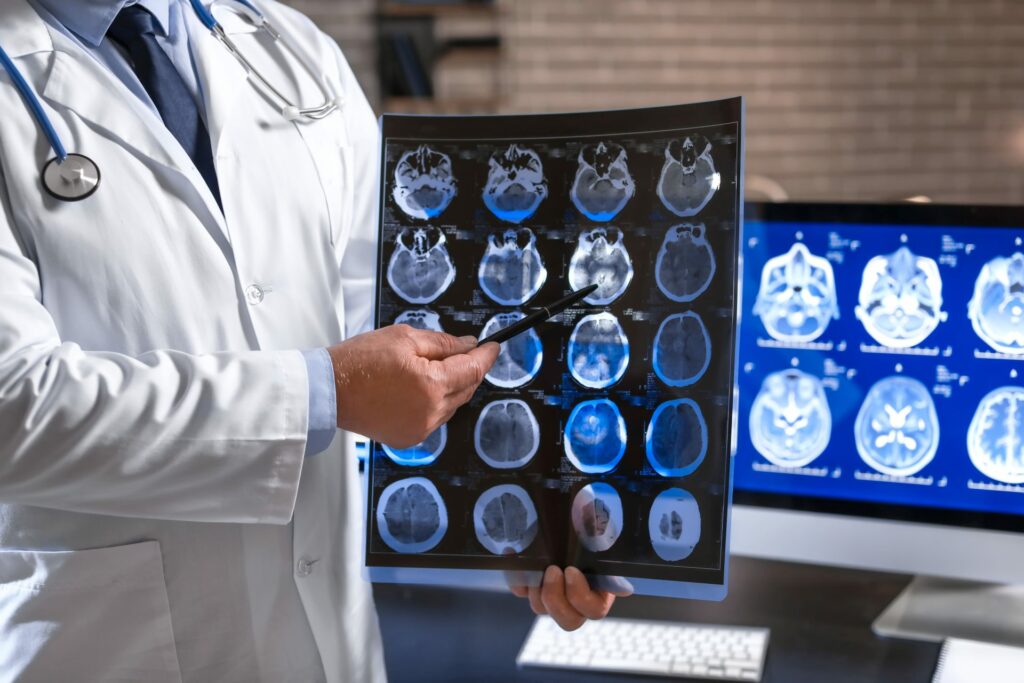
If you have been advised to get an EEG, EMG, or NCV, the names can sound technical and unsettling. The good news is that these tests are used to answer very specific questions, and each one helps us look at a different part of the nervous system.
In simple terms, an EEG studies the brain’s electrical activity, an EMG studies the electrical activity in muscles, and an NCV test studies how well electrical signals travel through nerves. Understanding the difference between EEG, EMG and NCV helps you see why one test may be appropriate for seizures, while another is used for weakness, numbness, tingling, or suspected nerve damage. These distinctions reflect how EEG evaluates brain activity, while EMG and nerve conduction studies evaluate muscle and peripheral nerve function.
If your symptoms involve blackouts, seizures, weakness, tingling, or unexplained nerve-related complaints, the right test can bring us much closer to the real diagnosis.
Medically guided by Dr. Siddharth Kharkar
Trusted neurological guidance that turns complex symptoms into clear next steps. Focused on helping patients and families understand why tests like EEG, EMG, and NCV are ordered, what they show, and when early neurological evaluation matters.
A quick answer
Here is the short answer.
EEG stands for electroencephalogram. It records electrical activity from the brain using electrodes placed on the scalp. It is commonly used when we need information about seizures, epilepsy, episodes of altered awareness, or other brain-related conditions.
EMG stands for electromyography. It records the electrical activity of muscles, usually with a small needle electrode placed into selected muscles. It helps us understand whether weakness or muscle symptoms may be coming from a muscle problem, a motor nerve problem, or the connection between the nerve and the muscle.
NCV stands for nerve conduction velocity, often performed as part of a nerve conduction study (NCS). It uses surface electrodes and small electrical impulses to measure how fast and how strongly nerves conduct signals. It is commonly used to evaluate nerve damage, nerve compression, or neuropathy.
So, when patients ask about the difference between EEG, EMG and NCV, the most useful answer is this: EEG looks at the brain, EMG looks at muscles, and NCV looks at nerves.
At a glance
Test | What it measures | Where it focuses | Common reasons it is ordered | What it feels like |
EEG | Brain electrical activity | Brain | Seizures, epilepsy, episodes of altered awareness, some forms of confusion | Usually painless |
EMG | Muscle electrical activity | Muscles and motor nerve-muscle connection | Weakness, muscle disease, suspected neuromuscular problems | Needle-based discomfort can occur |
NCV / NCS | Speed and strength of nerve signals | Peripheral nerves | Numbness, tingling, neuropathy, nerve compression, carpal tunnel syndrome, radiculopathy | Mild electrical stimulation, usually brief tingling |
This pattern matches the way leading neurology and hospital resources describe these tests for patients.
Why doctors order EEG, EMG or NCV
Doctors do not order these tests randomly. Each one is chosen because it answers a different clinical question.
Symptoms that may lead to an EEG
An EEG is most useful when we need to examine brain activity. It is commonly considered in people with seizures, suspected epilepsy, blackouts, unexplained episodes of staring, fainting in selected contexts, memory lapses, or changes in awareness that raise concern for abnormal brain electrical activity.
In other words, EEG helps when the question is, “Could this symptom be coming from abnormal activity in the brain?”
Symptoms that may lead to EMG and NCV
EMG and NCV are more often used when symptoms suggest a nerve or muscle problem outside the brain. These symptoms include muscle weakness, numbness, tingling, burning sensations, nerve pain, suspected peripheral neuropathy, carpal tunnel syndrome, radiculopathy, or other nerve compression syndromes.
When the question is, “Is this coming from the nerve, the muscle, or the communication between them?” EMG and NCV usually give us far more useful answers than an EEG.
Why more than one test may be needed
Sometimes one test is not enough. EMG and NCV are often done together because they provide complementary information. NCV tells us how well the nerve is conducting, while EMG helps us understand how the muscle is responding and whether the motor system is functioning normally.
That is why one patient may need only an EEG, while another may need EMG plus NCV, and occasionally the broader neurological picture determines whether more than one type of testing is required.
What an EEG measures
An EEG measures the electrical signals produced by the brain. Small electrodes are placed on the scalp, and the test records brain wave patterns that can help us see whether abnormal electrical activity is present. Cleveland Clinic describes EEG as a test that tracks the brain’s electrical signals and is often used to diagnose conditions such as epilepsy.
When EEG is useful

EEG is especially helpful in the evaluation of seizures and suspected epilepsy. It may also be used in specific situations involving confusion, altered awareness, or other symptoms where brain electrical activity is part of the diagnostic question.
For patients and families, it is useful to remember that EEG is not a test for muscle weakness or peripheral nerve damage. Its role is very different.
What happens during an EEG
During the test, electrodes are attached to the scalp. The test records signals from the brain while you are awake, and in some cases while drowsy or asleep, depending on the type of EEG being performed. Routine EEG, prolonged EEG, ambulatory EEG, sleep EEG, and video EEG are all recognized forms depending on the clinical situation.
EEG is generally painless. That makes it less intimidating than many patients first expect.
What an EMG measures
An EMG measures the electrical activity generated by muscles. It helps determine whether muscles are receiving and responding to nerve signals appropriately, and whether the problem may lie in the muscle itself, the motor nerve, or the connection between the two.
When EMG is useful
EMG is commonly used when we are evaluating weakness, suspected muscle disorders, motor nerve disorders, myopathies, neuropathies, and certain neuromuscular junction conditions. It can also help localize the presence, location, and extent of disease affecting muscles and motor nerves.
This is why EMG often becomes important when a patient says, “My hand feels weak,” “My leg is not working properly,” or “I have ongoing muscle symptoms and I do not know why.”
What happens during an EMG
In a standard EMG, a small needle electrode is inserted into selected muscles to record their electrical activity. Neurologists often perform the EMG after the nerve conduction portion has already been completed. The test can be uncomfortable, but it is usually brief and gives very valuable information.
That honest expectation-setting matters. Most patients do better when they know the test is useful, focused, and temporary.
What an NCV test measures
An NCV test, usually part of a nerve conduction study, measures how fast and how strongly electrical signals travel along a nerve. It focuses on peripheral nerves rather than the brain. This makes it especially useful when symptoms point toward nerve damage, nerve compression, or neuropathy.
When NCV is useful
NCV is often used in conditions such as peripheral neuropathy, carpal tunnel syndrome, sciatica, and other compression syndromes. Johns Hopkins notes that NCV is often used along with EMG to distinguish nerve disorders from muscle disorders.
So if someone has numbness, tingling, burning pain, or suspected nerve entrapment, NCV may be one of the most informative tests we can order.
What happens during an NCV test
During the nerve conduction study, electrodes are placed on the skin over specific nerves. A mild electrical impulse is given, and the response is recorded to see how quickly and effectively the signal travels. Cleveland Clinic explains that the sensation may feel like mild tingling or a static-electricity type shock and is generally brief.
Unlike EMG, NCV does not usually involve needle recording in the muscle. That distinction is important and often reduces unnecessary fear.
EEG vs EMG vs NCV: which test fits which symptom?
This is usually the most practical part of the discussion.
Seizures, blackouts and episodes of altered awareness
When the main concern is seizures, epilepsy, staring spells, episodes of altered awareness, or other symptoms suggesting abnormal brain activity, EEG is usually the more relevant test. EEG is designed to evaluate brain electrical patterns, not peripheral nerves or muscle function.
Weakness, tingling, numbness and muscle pain
When the concern is weakness, tingling, numbness, burning, or suspected nerve or muscle disease, EMG and NCV are usually far more useful than EEG. NCV helps assess the nerve signal, and EMG helps assess the muscle response and motor pathway involvement.
Suspected neuropathy, nerve compression or radiculopathy
If the pattern suggests peripheral neuropathy, carpal tunnel syndrome, sciatica, or radiculopathy, EMG and NCV are frequently the tests that help identify the problem and narrow the site of involvement.
The most important thing to remember is that similar symptoms can come from different causes. A proper neurological examination still guides which test is appropriate.
How to prepare for EEG, EMG and NCV
Preparation is usually straightforward, but it matters.
For EEG, patients are commonly advised to wash their hair beforehand and avoid hair products because electrodes need good contact with the scalp. Depending on the EEG type, there may also be instructions about sleep or caffeine.
For EMG and NCV, it is generally advisable to wear comfortable clothing and avoid creams, lotions, or perfumes on the skin, since they can interfere with the study. It is also important to inform the doctor if you have a pacemaker or other implanted electrical device, and to review medications when relevant.
A prepared patient usually has a smoother testing experience and a better understanding of what will happen.
Do these tests hurt? Are they safe?
This is one of the most common questions, and it deserves a direct answer.
EEG is generally painless because it only records electrical activity from the scalp.
NCV can feel like a brief tingling or mild electric shock. It may startle you, but most patients tolerate it well.
EMG can be uncomfortable because a needle electrode is inserted into selected muscles. That said, the discomfort is temporary, and the information from the test can be extremely important in reaching the right diagnosis.
These tests are generally safe, but like any medical procedure, they should be ordered for the right reason and interpreted in the right clinical context.
What the results can and cannot tell us
One of the biggest misconceptions is that these tests give a diagnosis in isolation. In reality, they are pieces of the puzzle.
An EEG can show patterns that support seizure-related diagnoses or other abnormalities in brain electrical activity, but it has to be interpreted alongside the patient’s symptoms and neurological history. EMG and NCV can help identify whether weakness, numbness, or tingling are more likely to be related to nerve damage, muscle disease, or nerve compression, but these results are also read in context. Cleveland Clinic specifically notes that nerve conduction study results are assessed together with symptoms, history, and other tests.
That is why expert neurological interpretation matters. The test is important, but the clinical reasoning around the test is just as important.